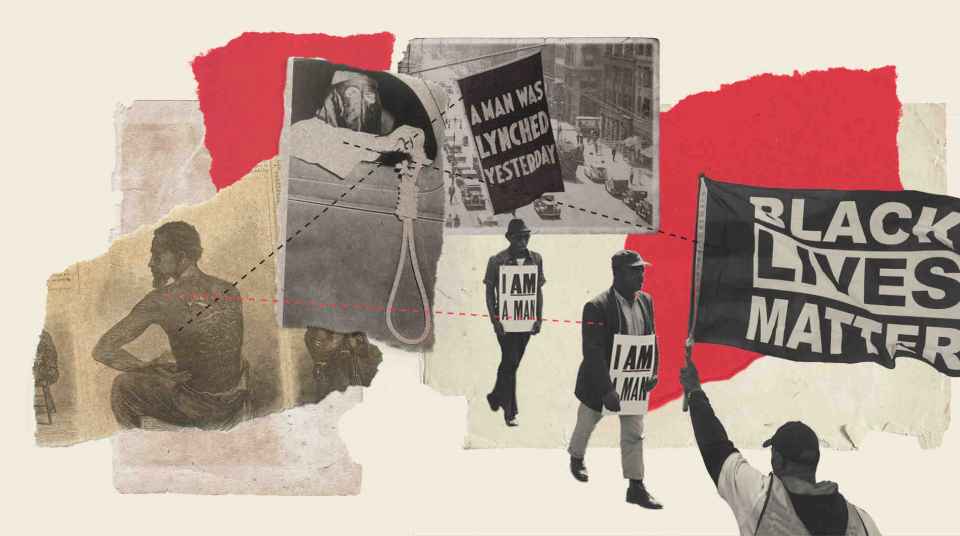
Reparations? Reparations. Reparations! Yes, the r-word has become the new buzzword in politics and in the media. The Internet is rife with countless Intellectuals and politicians giving their two cents about the hot topic. And if there’s nothing better to bring out the animosity and good old-fashioned American ‘what’s mine is mine’ attitude peppered in with a little unassuming racism is the topic of slavery, which the whole reparations debate centers around. America has never rectified its original and very profitable sin, slavery, or his rope-wielding cousin, JC, aka Jim Crow, save for a couple of apologies from Congress, and proponents believe it’s time for America to put its money where its mouth is.
As hot as the topic is currently, you wouldn’t have imagined that the first reparations bill, HR-40, was introduced exactly 30 years ago, in 1989 by John Conyers and has been reintroduced to every Congress since. I admire Mr. Conyers’ tenacity but it doesn’t seem like America is truly ready to financially account for it atrocious past. Does it really take 30 years to pass a bill, that is not even going grant reparations ladies and gentlemen, but will merely convene a commission to begin to ‘study slavery, its subsequent racial and economic discrimination against freed slaves,… the impact of those forces on today’s living African Americans…and make recommendations to Congress on appropriate remedies to redress the harm inflicted on living African Americans.’ So if we can’t even pass a bill in 30 years to just study reparations, I think we are another 100 years away from expecting the government to actually take any financial responsibility. And if we put our thinking caps on, one logical conclusion for America’s unwillingness to pass even a ‘study bill’ is because….drumroll please, of the obvious complicity of the government in the economic status of Blacks in America. Maybe, just maybe…
But, like with any good debate, there are those who disagree with the whole notion of reparations. These people feel like slavery happened 150 years ago and that no one alive today is personally responsible for that grave injustice. They are just reaping the benefits. To those, I say this: while it is true that the original slave owning forefathers are dead and gone, the racist spirit and sentiment upon which they built this nation continues to exist to present day, resulting in inequalities manifested in our educational systems, ability to access and maintain wealth, health care institutions, justice system, and nearly every aspect of black life in America. Those same racist sentiments that institutionalized slavery, also passed polices to preclude blacks from competing economically, refused to give loans for our businesses and homes, burned our neighborhoods and hung us when we found ways to excel even against all the odds.
And while I personally feel that America is accountable and should do something in the form of reparations, there are many others who look like me but disagree. A study done in 2016 showed that 32% of African-Americans don’t approve of reparations. Not surprisingly, a whopping 85% of whites disapprove of reparations. So I had to learn more about that 32%, and, it was brought to my intrigued attention that this 32% didn’t want to be reparated (yes I conjugated that as I saw fit) because they felt the acceptance of would make them victims, or that white people would have more reason to look down on us and hate us. As I listened to their arguments, I couldn’t help but assume they lived in a different America than I. In my America, we are still victimized every day, whether we are given reparations or not. We are victims of an unjust system. I am the victim of schools that didn’t even have books for students to take home (probably why I make my own conjugations?). My brothers are the victims of an unjust legal system. And while I personally never worry about how white people, or any people, for that matter view me, I don’t think we are currently viewed highly favorable, unless we’re singing, dancing or balling, so…
Other detractors feel a reparations program would be too difficult to implement, which in my opinion, is one of the laziest reasons to oppose reparations. Most policies take some time to figure out, that doesn’t make them impossible or unworthy of passing. In addition, I argue that blacks wouldn’t be the first to be given reparations. The US government has given reparations before, in the form of cash or land settlements to Native Americans, and in a settlement paid to interned Japanese citizens. Though arguers always say those were much more cut and dry cases, and while I don’t argue they are incorrect, as I don’t know or claim to know all the details, I decline to believe it’s impossible to devise a settlement for African-Americans. It should also be noted, that while these groups were given reparations, they were not necessarily reparated at a fair value. Way to go America!
Now while I think America should reparate, I’m not holding my breath and don’t think it’s something that’s going to happen. The initial idea of reparations was introduced by Union General William Sherman in Special Field Order 15, in which freed slaves were supposed to be given 40 acre tracts of land, what we now commonly refer to as ’40 acres and a mule’. The government had the land ready to roll out along the East coast, stretching from Charleston, South Carolina to the St. John’s River in Florida. President Lincoln approved the order, but was assassinated before its implementation. The order was immediately revoked once Andrew Johnson took office and the slave owners were compensated instead. Since Field Order 15, there has been no formal legislation, just many, many debates.
And the conversations and debates continue, and will most likely continue until our grandkids are talking about it. In my idealistic mind, reparations can and probably needs to take many forms. For me, the beginnings of a reparations plan would begin to solve for the systematic inequalities we experience as blacks in America. Reparations should be used to improve our schools, our health, our communities. Reparations should be used to provide for access to colleges and entrepreneurial endeavors. Reparations should begin to repair the exponential generational wealth African-Americans lost during slavery and Jim Crow that is now realized as a 10:1 disparity in wealth. For every $1 black families have, white families have $10. The National African-American Reparations Commission has developed a notable 10-Point Plan for what reparations can look like, taking some of the work out of the perceived difficulty of implementing reparations.
While it would be wonderful and amazingly mature for America to acknowledge and begin to write its long history of injustices, I’m not hopeful at all. I think we need to continue to focus on community empowerment, group economics and relying on ourselves as the most powerful solution. I’d love for America to atone and write some checks, but aside from my research into and writing of this article, this is probably where reparations will begin and end for me but I gratefully appreciate everyone who is fighting the reparations fight because if it does happen in my lifetime, you know I’m going to get me a check!


Drop a Thought!